
A Non-Biological Reason for Why Information Cannot Flow from Proteins to DNA
"..the Central Dogma is a theorem of coding theory and not a fundamental biological phenomenon." - Hubert P. Yockey


I chanced upon an elegant way to think about this question in Hubert P. Yockey's Information Theory and Molecular Biology published in 1992.
First, some preliminaries:
The Central Dogma says that the primary direction of the flow of genetic information in biology is from DNA to proteins (via RNA). In some special cases, it can go from RNA to DNA and RNA to RNA, but under no circumstances can it flow 'back' from proteins to nucleic acids. No cellular machinery exists that can read protein sequences to synthesize DNA or RNA.
Thinking in terms of source and receivers of information, the nucleic acid "source" has 64 code words or codons (number of possible triplets of A, T/U, G, C) that encode for a sequence, made up of 20 words (amino acids), that is transferred to a protein (a "receiver"). Of the 20 amino acids, 18 have multiple codons (only methionine (AUG) and tryptophan (UGG) are specified by a single codon each). This redundancy means that the genetic code has multiple ways to encode most amino acids, making it "degenerate."
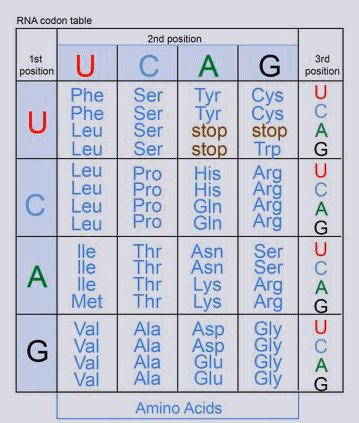
So the information travels from a source with 64 code words to a receiver with a 20-letter vocabulary. Can it flow in the opposite direction: from a source with 20 code words to a receiver with 64-letter vocabulary?
The answer lies in a dice game. Suppose your friend has a pair of dice: one red and one white. The different colors allow her to distinguish between (3,5) and (5,3). She rolls the dice and tells you the sum of the numbers on the dice, say 7. There is no way for you to know the numbers on individual dice. You have no way of knowing whether it is (1,6), (2,5),(3,4), (4,3),(5,2) or (6,1).
This dice game is isomorphic to the question above. This dice game has its own version of the Central Dogma of unidirectional information flow. This unidirectionality is a property of all degenerate codes where the source has more symbols in its alphabet than the destination. For information to flow bidirectionally, the number of symbols must be equal.