
Is Mars Rover Life?
Assembly Theory and the Definition of Life

1. Is Life Emergent or Assembled?
If aliens from another galaxy land on Mars and encounter NASA’s Curiosity rover, have they found signs of life? More intriguing: have they found life?
Let’s reverse the situation. When we humans send out probes in the Solar System (and beyond) to find life, how will we know when we have encountered it?
These questions hinge on how one defines Life: a phenomenon that famously eludes satisfactory definition. The only scientific consensus about the definition of Life is this: “Every definition of life includes some things it should exclude and excludes some things it should include.”
Scientists used to argue whether fire was alive: It has metabolism (oxidation), growth, responds to stimuli, and reproduces (by spreading). Mules and other sterile species are excluded by any definition that includes reproduction as one of Life’s features. And viruses are excluded if you insist on ‘autonomous’ reproduction, because they require a host.
Even the famous NASA Working Definition of Life from the 1990s, that “Life is a self-sustaining chemical system capable of Darwinian evolution,” excludes, if taken to extremes, an individual human. Because no human is self-sustaining: we are obligate parasites of our environment. If you isolate a human from the biosphere, the “self-sustaining” system fails immediately.
All of this means that the field is ripe for a paradigm shift. As Thomas Kuhn would say, the time is nigh for a “reconstruction of the field from new fundamentals.” Assembly Theory, pioneered by Lee Cronin and Sara Imari Walker and their respective teams in the 2010s, aims to provide these new fundamentals.1
Most attempts at defining life focus on what life does, like metabolism or replication or undergoing Darwinian evolution. Assembly Theory defines life by the Assembly Index, which is the “shortest non-random synthetic pathway” that produces complex objects. It shifts the focus from what Life is (or does) to the history of how it was assembled.
In science, new theories win out by doing three things. First, they preserve the successes of the old theory. Second, they explain the anomalous observations incompatible with the old theory. And third, they make falsifiable predictions beyond the reach of the old theory. Often, scientists discover and construct new theories by reconceptualizing familiar concepts.2
In the first half of the 20th century, light was shown to behave as particles, and atoms (i.e., matter itself) were shown to behave like waves. We had to change our understanding of what we mean when we talk about ‘light’ and ‘matter,’ beyond the colloquial or dictionary definitions of those words. These were the reconceptualizations brought forth by quantum theory.
Assembly Theory similarly seeks to reconceive what we mean by ‘objects,’ ‘information,’ ‘lineage,’ and ‘time’ to build a physics where selection and evolution are fundamental. This framework is then employed to demarcate that indescribably fuzzy boundary between “living” and “non-living.” Central to this is the idea of path-dependence.
2. Does the Universe have Amnesia?
Twentieth-century leaps in physics were profound: we graduated from the naive determinism of classical physics to speaking in terms of statistics and probabilities. And in the statistical reframing of physics, the current state of the universe—and of the things currently in it—is not dependent on the path that the universe took to get here. A photon is a photon whether it originated at the Big Bang or a second ago on this screen.
Another implication of path-independence is this: statistical physics says that, given enough time, literally any configuration of matter (allowed by physics) is possible. Think of that famous saying about a million monkeys typing on a million typewriters to ultimately conjure up the Shakespearean canon.3 A more egregious thought experiment is the Boltzmann Brain: as per the statistical view, it is possible that your brain—with all its memories—was assembled right at this moment by random fluctuations of the particles in the universe. This is the absurdity of path-independence.
Assembly Theory says that while chance might produce Hamlet once, it cannot produce it twice. If the same complex sequence appears repeatedly, the system is no longer operating by chance. It has developed a ‘memory’—a physical mechanism for reproducing specific, high-complexity paths that lead to Hamlet and brains and Life.
Life is path-dependent. Forget about something as complicated as a human brain; even a ‘simple’ bacterium cannot exist without the 4-billion-year evolutionary history behind it. We can even go down another level: even the biomolecules that make the bacteria, like proteins and DNA and lipids, cannot exist without their evolutionary history. And current theories of life are, at best, agnostic towards its path-dependent nature.
Twentieth-century biology sees life as an emergent phenomenon. The classic way to explain emergence is using the example of “wetness.” An individual molecule of water is decidedly not “wet.” But given enough water molecules, “wetness” becomes the emergent property of the collection of those molecules. Similarly, in the traditional emergence view, life is a property that ‘appears’ once a system reaches a certain level of collective organization. Assembly Theory, however, argues that life isn’t a mysterious property that pops into existence. Instead, life is a measurable accumulation of historical steps required to build a complex object.
The problem isn’t that statistical physics is random and emergence is vaguely defined, but that both of these concepts are ‘memoryless.’ If you are only thinking in terms of probabilities and emergence, you are not thinking about the paths that things take. As the incredulity of the Boltzmann Brain implies, selection and evolution appear to be fundamental aspects of reality. What current physics lacks are the variables of ‘object,’ ‘memory,’ ‘lineage,’ and ‘time’ conceived in a way that treats selection and evolution as fundamental.
Assembly Theory says that Life is what happens when the universe’s ability to copy and persist complex structures outweighs the random noise of the environment. It claims that life is a physical process of time compression. A living thing is a place where a massive amount of historical assembly has been packed into a small space. The Universe remembers.
And there’s a way to quantify this.
3. Object and Time in Assembly Theory
One of the concepts that Assembly Theory reconceptualizes is that of an Object. In AT, by definition, an Object must have a well-defined boundary and be decomposable into building blocks. This concept is usually illustrated by a LEGO castle. In AT terms, a LEGO castle is a collection of basic building blocks (in this case, LEGO bricks) joined in a specific sequence.4
The Assembly Index (ai) is the shortest path to build an object from its basic building blocks. The shortest path is the one with the fewest steps. What this means is that, in the case of a LEGO castle with four bridges, once you have made one bridge, you can “reuse” that part. In AT, there are only two operations allowed: Addition (adding a basic block) and Symmetry/Duplication (using a structure you have already built in a previous step). Assembly Index, hence, can also be thought of as the minimal instruction manual.

At the risk of breaking the analogy: for a linguist, the object might be a word, and the building blocks are letters. Take the word “BANANA.” If your building blocks are letters (B, A, N), what is the smallest number of "steps" you need to build the word if you can reuse any sequence you've already made?5
For a (bio)chemist, the object is a (bio)molecule, and the building blocks are chemical bonds. A simple molecule like Water (H2O) doesn’t take many steps to put together, and hence has a low assembly index. A complex protein or a DNA strand, on the other hand, requires a massive number of specific, sequential steps.
A radical implication of Assembly Theory concerns the concept of time. AT suggests that time is actually “encoded” into complex objects because they require a history of steps to exist. You cannot have a high-ai object without the specific sequence of events that created it; therefore, time is seen as an intrinsic part of a complex object. Another implication is that the assembly index measures the intrinsic complexity of an object, not its relative complexity. The number of atoms in a molecule doesn’t matter so much as how much information or history is required to make it.
This matters for defining Life because random chemical reactions can easily make simple things from a messy collection of chemicals. But as the number of steps (ai) goes up, the odds of a complex object forming by pure accident drop exponentially. Assembly Theory predicts that abiotic (non-living) processes cannot produce objects(plural) that require more than ~15 assembly steps. This ai of 15 marks a clear physical boundary between chemistry and biology.6 It’s like trying to shake a box of LEGOs and hoping they accidentally form a castle. It’s just not going to happen without a ‘constructor’ (another AT concept we will look at shortly).
However, finding one object with the assembly index of ~15 doesn’t completely rule out an abiotic process. But finding two such objects does. If shaking a box of LEGOs does somehow accidentally form a castle once, it surely cannot form the same castle twice. This is where the second important parameter of AT becomes relevant: the copy number (ni). And ni is closely related to the ‘constructor’ in AT.
4. One, Two, and Many
If you find one copy of an object—a complex molecule, say—with an assembly index of 20 (i.e., it takes 20 steps to make that object), you may still consider it a fluke, a highly unlikely result of a complex synthesis pathway walked by random thermal fluctuations. However, finding a second copy is exponentially more unlikely. If it takes twenty steps of synthesis to make that molecule, and each step has a ten percent chance of happening, then the odds of making the molecule once would be 1 in 1020. And the odds of making it twice by pure luck are 1 in 1040. The universe will have to travel perfectly along the same unlikely path again.
Hence, a copy number of 2 implies something more intriguing. It implies the existence of a ‘constructor’: a catalyst, a template, or a reaction cycle that ‘remembered’ the specific sequence of steps to make them happen again. In Assembly Theory, information is the ‘memory’ that allows the universe to repeat a specific construction path.
At copy number 1, path dependence remains unproven: the object may have appeared with a low probability, as predicted by statistical physics. Copy number (ni) is how Assembly Theory distinguishes between chance and selection. Once is happenstance, twice is selection.
In Assembly Theory terms, at copy number 1, there is no selection. The universe ‘tried’ a path but didn’t ‘keep’ it. Copy number 2 is the first evidence of selection. It implies that the universe now has a local memory of how to make that object. A higher copy number means selection is now the dominant force. It means we have reached a state where selection ensures the persistent reproduction of high-complexity objects.
Assembly Theory predicts that abiotic (non-living) processes cannot produce high copy numbers of objects with more than ~15 assembly steps, marking a clear physical boundary between chemistry and biology. A simplified formula is (High Assembly Index) + (High Copy Number) = Life.7
This is also how Assembly Theory reframes the Origin of Life. It moves away from the search for a specific ‘first organism’ and instead describes a phase transition in how the universe organizes matter. Life begins the moment a Constructor (a set of chemical instructions) allows a system to move from a copy number of 1 to a copy number of 2 for a complex object.
Similarly, Assembly Theory reframes the question of biosignatures, which will tell us when we have encountered life elsewhere in the universe. Currently, when we look for life, we look for Earth-like biosignatures, such as oxygen or biomolecules similar to DNA and proteins. However, as stated previously, characteristics of Earth-based life are insufficient to define even Earth-based life. An AT-based approach, on the other hand, wouldn’t look for specific biomolecular alphabets. Instead, it would look for complex repetition, for high-assembly-index molecules in high-copy numbers.
If we find a puddle of strange purplish liquid on a moon of Saturn, standard chemical analyses might say there’s no life because there’s no DNA/proteins analogues. However, if we run a Mass Spec on the liquid and find millions of copies of a molecule with an assembly index of 25, we have found Life! Because, mathematically, the universe cannot “stumble” upon that specific 25-step molecular shape a million times by accident.
5. The Lineage of the Mars Rover
Let’s think back to the scenario of aliens encountering NASA’s Curiosity rover on Mars through the lens of Assembly Theory.
According to Assembly Theory, the aliens have definitely found signs of life.
The rover has a high assembly index. Not only that, its constituents have a high assembly index too. It is made of complex microchips, specialized alloys, and intricate sensors. The shortest instruction manual to build a computer chip from scratch is thousands, if not millions, of steps long. The aliens’ probes would find millions of identical transistors, identical screws, and identical sensors, i.e., a high copy number of high-assembly-index objects. As per Assembly Theory, the aliens would conclude that this object cannot be a fluke. It is a product of a persistent, selective process.
This is where Assembly Theory gets audacious. AT goes further, saying that the aliens have found life itself, not just signs of life.
This requires a sharp distinction between being ‘Alive’ and being ‘Life.’ A rover is not alive. But it is Life. In the Assembly Theory framework, ‘Life’ on Earth is the four-billion-year physical lineage of selection that makes an object possible, whereas ‘Alive’ is merely the temporary state of a biological engine currently running. A dinosaur fossil or a dead animal is no longer alive, but in Assembly Theory, they remain Life. They are high-assembly objects that the universe could have produced only through a specific, persistent history of selection.
Assembly Theory argues that the rover is a physical manifestation of Earth's biological assembly space. The rover couldn't exist without the 4-billion-year history of Life's evolution on Earth. It is the extension of the same lineage that started when life began on Earth. To an alien educated in Assembly Theory, the rover is a high-assembly object that proves a living constructor exists (or existed) nearby.
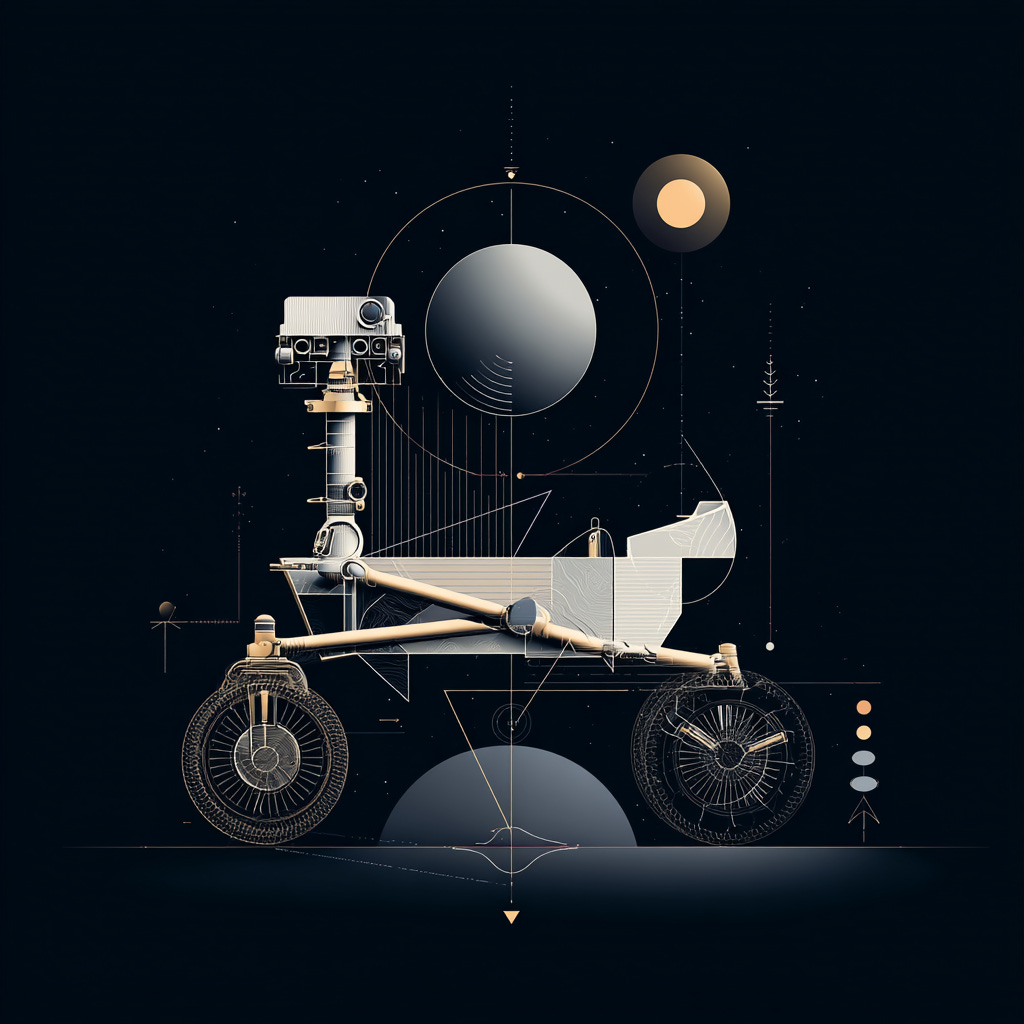
Assembly Theory treats Technology as a continuation of Biology. In AT, Life is the process, not just the individual. Finding the rover is finding a “limb” of the Earth’s living system. Biology uses DNA to assemble proteins. Technology uses Human Brains and Factories to assemble rovers. Both are ways in which the universe compresses time into complex, repeating objects. In a random universe, everything complex is unique (like a snowflake). In a living universe, complex things are copied (like a blade of grass, or a transistor on a rover). Life is when we find complexity that is no longer unique.
One bug-that-is-a-feature of Assembly Theory is that AT might not be able to tell the difference between an alien microbe and an alien nanobot. To AT, it doesn’t matter. Both are high-assembly objects. As long as life assembles complex objects from simpler parts and repeats that process, AT will detect it. If we find a complex, repeated structure, we know we’ve found a lineage of selection.
6. What would Deutsch, Popper, and Kuhn Say?
The framework for how new scientific theories win out, as mentioned at the beginning of this piece, draws from Karl Popper, Thomas Kuhn, and David Deutsch.
“Preserving the successes of old theory” criteria is associated with Kuhn. If Einstein’s relativity couldn’t predict the orbit of the planets as well as Newton’s, nobody would have listened. This is why Assembly Theory must still yield the standard chemistry and physics results when the complexity is low. AT acknowledges that for simple systems (low ai), the laws of statistical mechanics are sufficient. It preserves the idea that energy is conserved and that entropy increases globally. But it argues that while entropy is the law of the universe, Assembly is the local law of life.
The invocation to “explain anomalous observations” is the heart of Kuhn’s influential book The Structure of Scientific Revolutions. The anomaly Assembly Theory aims to address is the existence of trillions of identical, complex molecules (like ATP) that statistical mechanics says shouldn’t exist. AT explains it by introducing selection as a physical law.
Karl Popper proposed the requirement of falsifiability. Popper argued that for a theory to be scientific, it must stick its neck out. It must say, “If you see X, I am wrong.” If a theory can explain everything after the fact but predicts nothing specifically, Popper called it pseudoscience. In Assembly Theory, the prediction that no abiotic process can cross the ai≈15 threshold is a Popperian falsifiablity criteria. If a scientist finds a volcano or a random lightning strike that creates a large amount of a molecule with ai=25, Assembly Theory is dead.
David Deutsch built upon Popper’s work to come up with the concept of explanatory power in his book The Beginning of Infinity. He posits that the best theories provide a new "hard-to-vary" explanation of reality. This is where reconceptualizing familiar concepts comes from. In Assembly Theory, the move from seeing an object as a ‘thing in space’ to seeing it as a ‘lineage in time’ increases explanatory power. It helps us define Life unambiguously.
For the primary scientific literature on Assembly Theory, see: Marshall et al., Nature Comm. (2021) for the experimental validation of the 15-step threshold; Sharma et al., Nature (2023) for the formal mathematical framework; and Cronin & Walker, Science (2016) for the conceptual argument for moving beyond traditional prebiotic chemistry.
My gratitude to Mike Riggs, Hiya Jain, and Steven Adler for their incisive feedback on the later drafts. And my thanks to Grant Mulligan, Rob L’Heureux, Julius Simonelli, Byron Cohen, Rishi Pethe, Lauren Gilbert, and Mike Riggs (again) for their troubling questions and helpful comments on the earlier drafts.
Walker has written the first comprehensive popular treatment of Assembly Theory and its implications for astrobiology: Life as No One Knows It: The Physics of Life’s Emergence (2025).
For example, Einstein reframed gravity as a result of the fabric of spacetime being distorted by the presence of any object with mass. His theory of general relativity predicted that this distortion would bend light itself near a sufficiently massive body (this prediction was out of reach of the Newtonian concept of gravity as a force between two masses). Eddington confirmed this prediction by measuring the bending of starlight due to the Sun during the 1919 total solar eclipse.
“..now, thanks to the internet, we know that’s not true.” — Robert Wilensky. AT doesn’t entirely rule out this happening once. But if it happens more than once, then AT says there’s a ‘memory’of Shakespearean cannon somewhere in the system of monkeys and typewriters that’s allowing it to happen.
The bricks here are defined as a basic building block. We don’t care how the brick was made; we only care how the bricks are put together to make a castle. The basic building blocks are the entities that exist outside the assembly process we are currently measuring. They are the “givens” of the system. To avoid an infinite loop where everything is an object, AT usually sets a ‘floor’ based on the problem being solved.
4. Now do “ASSASSIN”.
The threshold of ai≈15 is an empirical boundary derived from the probabilistic brick-wall of combinatorial explosion. In a random (abiotic) universe, the number of possible molecular configurations increases exponentially with each assembly step; by the time a sequence reaches 15 steps, the chemical search space becomes so vast that the probability of forming multiple identical copies of a specific structure through unguided stochastic collisions becomes effectively zero. This specific value was validated by the Cronin Group through mass spectrometry analysis of diverse samples, which demonstrated that no known non-living system (including meteorites and complex prebiotic soups) produced detectable concentrations of molecules exceeding this complexity, whereas biological and technological samples consistently surpassed it.
The expanded equation is:
The (ni−1) Term: The subtraction of 1 is the selection filter. It ensures that any object with a copy number of one (a statistical fluke) contributes exactly zero to the total Assembly of the system.
Normalization (Ntotal): Ntotal is the total number of individual objects detected within the sample, used as a normalization factor to ensure the system's Assembly value represents complexity density rather than mere sample size. Without this denominator, the value A scales with sample size rather than system complexity, which would be an amateur mistake in a formal paper.
The simplified form of the equation is also used in literature:
Thank you for your comment! And yes, that is a correct summary of Assembly Theory's definition of life. What's interesting is that the number 15 is an empirical threshold derived from experimental data and from theoretical modeling using Earth life. AT doesn't say it will always be 15, maybe there's another lineage of Life where the threshold is higher or slightly lower. Depending on the background abiotic noise, there is always some number where the universe shifts from randomness to selection. If we were to find an alien system where the abiotic noise is higher, maybe the threshold is 18 instead of 15. But the underlying logic is the same. This makes AT truly agnostic for finding life elsewhere.
Every once in a while, I happen across a piece of writing that changes the paradigm. It's why I am here on Substack to begin with. This is one of those pieces, and thank you to Venkatesh Ranjan for writing it!
You illustrate an age-old conundrum that we face when trying to differentiate matter from life: it escapes all attempts to define it via a characteristics approach. I noted this in an easier essay as well, where I wrote:
"A mule, for example, cannot reproduce, yet nobody would doubt that it’s alive. A virus, on the other hand, can reproduce, but most biologists consider it to be non-living because it depends on other species to do so. We wouldn’t argue that a crystal is alive, yet it grows. On the other hand, some bacteria go through dormant periods where they do not grow or metabolize at all, yet we still consider them alive."
https://risknprogress.substack.com/p/a-fortuitous-planet-part-2?r=8frpw
The delineation here is fuzzy, so I concluded that life is merely a special type of matter better suited to dissipating energy in accordance with the second law of thermodynamics. I suggest that our brains, to make sense of the universe, had drawn an arbitrary line between what is living and non-living.
If I am understanding correctly, however, Assembly Theory claims that this line is not arbitrary at all; any objects that require more than 15 steps to produce on the Assembly Theory Index and are duplicated, necessarily require a biotic origin because they are otherwise too improbable to have a chemical origin.
This ties right into the "knowledge" aspect of human progress: That the universe is looking for ways to accelerate energy dispersion and that life contains knowledge that compresses the time required to do so. Human industrial and technological actions, which require higher levels of knowledge, are merely extensions of this same process.
The implications here, however, are interesting, for it would also hold that our creations, including things like a Mars rover, are also "life" by this same definition; an extension of living processes. Mind-blowing.
I will be editing and revising my essay on this topic soon to include a discussion of assembly theory.